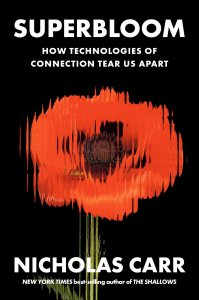
Nicholas Carr’s Superbloom, this incredible, expansive treatise (for that is the only word that seems to fittingly describe its scale and precision) is a revelation. Drawing from history, psychology, sociology, economics, linguistics, computer science, and a host of other disciplines, Carr brilliantly constructs a history of human communication – that is indeed, ultimately, an indictment of social media – and at once so much more than that.
His work begins with Charles Cooley’s conception of “social media” in the mid-19th century – not what we know today, typified by tech giants like Meta and X – but as groups of people through which information and influence spreads. Cooley perceived, even in those early days of communication technology, that the manner in which humans communicate (in)forms a message just as much, or indeed more than, the very content of that message itself. As methods of communication changed, so too would change human communication.
From there, Carr’s intellectual endeavor quickly and beautifully spirals upward and outward in the service of one of his central theses: that communication, as humans pervasively and insidiously believe, is not a panacea for conflict. It does not bring us closer together or ameliorate or render neutral the differences between us. Instead, the increasing speed at which we communicate – the march from letters to telegraph to radio to cell phone to email to social media and beyond – fosters political and personal misunderstandings; encourages speedy, error-prone System 1 thinking; divorces us from our physical world, from our communities, and from our very personhood; and ultimately leaves us more profoundly fragmented, especially when the individuals, governments, and corporations that are responsible for this progression are not accountable to us, and we are not accountable to ourselves.
But this is not the extent of Carr’s argument. It is far more textured and nuanced than I could possibly explain here, with planks concerning communication regulation policy, social media’s effects on mental health, psychological studies of neighborhoods, the advent of textspeak, and the ancient practice of letterlocking, to name precious few examples. The result is a nonfiction work of incredible depth and application, one that I evangelized even before I finished it last month, and that will have persistent relevance in my life and resonant effects on the formation of my worldview.
Superbloom is the brilliant articulation of a radical thesis: that, just as the superbloom of poppies that overtook California hills in 2019, and the delirium that can result from that plant’s seeds, our mind-rending, incomprehensible access to information, and to each other, has more repercussions than we at first supposed.
 In Extenso
Leave a comment