– January 2026 –
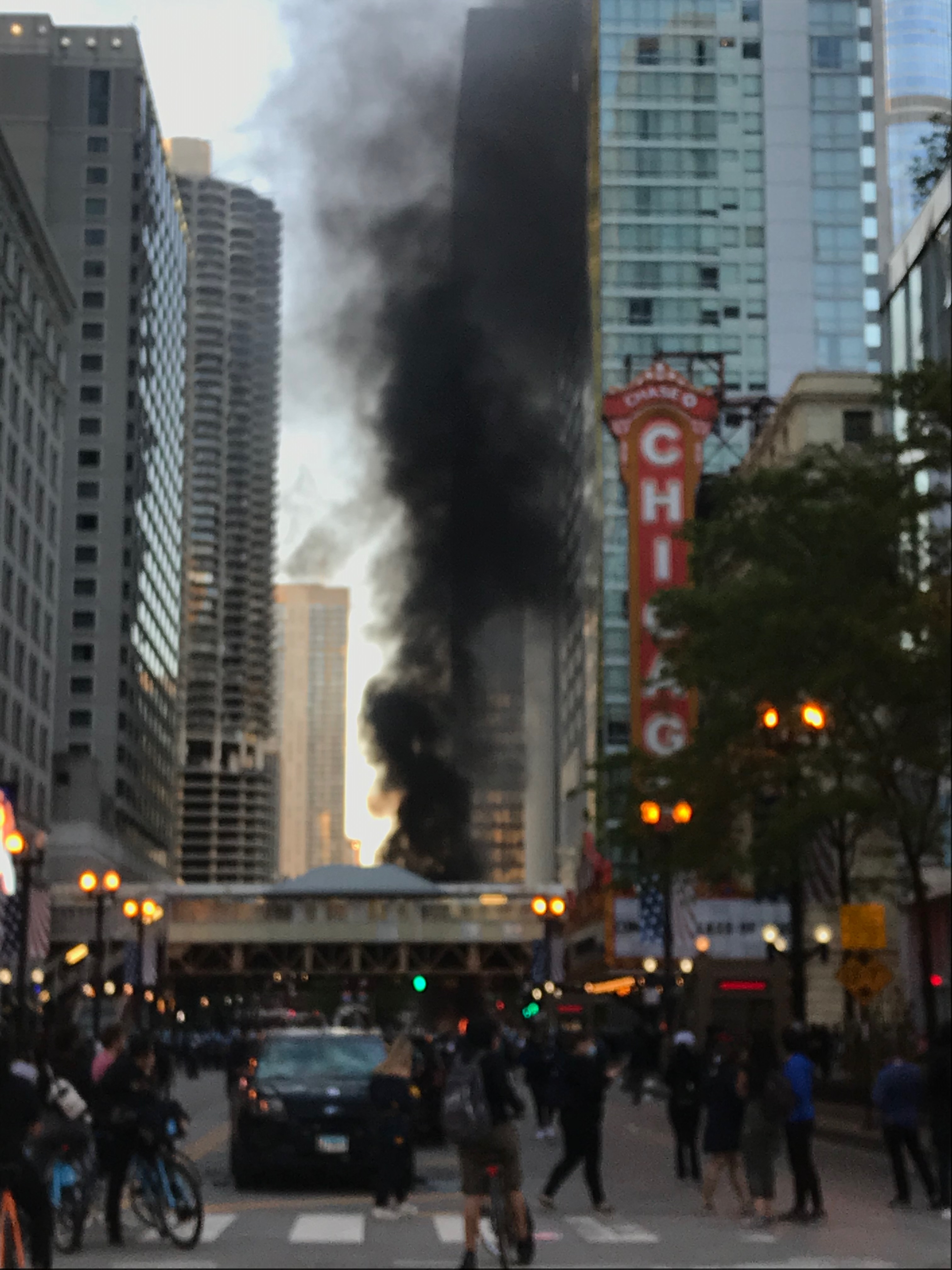
Five days after George Floyd’s death, I stood in a crowd of protesters, in turn cheering, jeering, and silent. A person dressed in all black reached over from where they stood on a telephone box and grabbed the edge of an American flag strung from the wall of a downtown building. After dousing it with lighter fluid, they fumbled to pull a lighter from their pocket, and held it beneath the last red stripe. Someone in the crowd screamed — anticipation or anger or something else. Chants of No justice, no peace! spread through the mass, then faltered. A full minute passed while the person struggled with the lighter. Then, as fire crawled up the fabric, they silently raised the flaming flag in their fist. The crowd erupted as the person jumped from the box. The flame quickly died.
Earlier that day, I took the bus to the demonstration before the city suspended public transportation across the Loop. On the way, a protest caravan caused gridlock in the streets. Stop police brutality! and Justice! were scrawled in paint marker across a Jeep. A man held a sign up through his sun roof — the names of Black Americans killed by police, written on sheets of printer paper and taped to a piece of cardboard. ACAB, spraypainted in big letters on the glass side of a bus shelter, welcomed passersby to the city center.
As night fell, smoke would begin to rise above the elevated train tracks, and police cruisers with smashed out windshields would litter the middle of the streets. What conservatives called senseless looting, and what I called uprising, would tear through downtown Chicago and throughout the neighborhoods.
Scenes like this characterized the nation after Floyd’s death. As a young Black girl, I had long known the risks of police violence — but Floyd’s killing catalyzed in me the undeniable awakening of a political consciousness, an unassailable conviction of right and wrong and, more than that, of justice. For me, those moments formed the baseline of my understanding of protest far into the future, and the practical foundation of theory I would later come to study.
For the nation, Floyd’s murder spurred a reckoning with the bounds of effective and acceptable protest. A schism formed among Americans over the property destruction, stealing, blocking traffic, and disruption that they witnessed in Minneapolis, Chicago, and other major cities.
Now, as Minneapolis again faces state violence, albeit in a different form, similar questions arise. President Trump’s immigration crackdown in the city — marked by forceful abductions, tear gas canisters, and bloodied protesters — has already caused two violent deaths in January: those of Renee Good and Alex Pretti.
The people of Minneapolis have not responded by causing destruction, but by standing sentinel. They tail ICE vehicles around the city, keep tabs on their movements, and capture endless footage when they assault the city’s residents. They also deliver groceries to those whose immigration status might be questioned. They blow whistles to alert their neighbors when ICE is near, and drive each other to school and work so no one has to be on the street alone.
On the precipice of a fall into fascism, we now stand in the shadow of George Floyd. Too concerned with whether those 2020 protests were acceptable, we neglected to ask if they were effective. Now, with Minneapolis in mind, we are forced to grapple with whether effectiveness can or must mean something other than forcing change — whether it can mean keeping each other safe.
With millions of dissenters in the streets, the George Floyd uprising in the spring and summer of 2020 was the largest protest movement in US history. Four months later, in September, a Louisville grand jury declined to indict the officers who killed Breonna Taylor, a Black woman, during a surprise raid on her home. By that time, I had begun to carry with me the images of violence and destruction that had wracked American cities since earlier that year. These memories were painful and loud — “Black-owned business” written on boarded windows like blood on the threshold of a door, asking for protection; the charged air in the space between a line of protesters and a line of police; the clamor that arose when someone strayed.
“And this discomfort, this pain, this heartbreak that follows knowledge of tremendous injustice, is exactly the goal of a protest,” I wrote in my high school newspaper, in a piece defending illegal Black Lives Matter demonstrations.
I wrote that in the eyes of former Chicago mayor Lori Lightfoot and Illinois Governor JB Pritzker, “the purpose of dissent is merely to express dissatisfaction and solidarity. … But the true aim of protest is to spur change. … It is then precisely because destruction of property and looting are painful — both emotionally and economically — that they are forms of protest.”
I hoped then, and I hope now, that when politicians or conservatives or proponents of traditional civil disobedience read these words, they know I did not defend riots because I think they are palatable or easy or even right. Rather, I believe they are political acts. Not, as Illinois politicians and others characterized them, merely instances of “straight-up felony criminal conduct.” I believed that protest must be destructive, or coercive, or uncivil, in order to force the hand of the powerful.
But with the clarity of retrospect, Minneapolis gives me pause. According to Robert F. Worth in The Atlantic, the religious groups at the forefront of current-day ICE resistance are “asking difficult questions: When does protest cross the line into violence? When is it morally acceptable to break the law? How do you retain the trust of people who are uncomfortable defying the authorities?”
I had thought, in high school, that “a protest is an action that citizens take against the disposition of their government, not in conjunction with it.” But when Worth catalogs the whistles, chants, and coordinated tactics that compose “a meticulous urban choreography of civic protest” — one that is law-abiding, for the most part, well-organized though ad hoc, civil but extremely dangerous — the city’s current resistance asks me to reevaluate my old opinions, and confront whether pure outrage is the truest form of protest.
When more radical methods may risk alienating potential supporters, how should the people of Minneapolis — and all of us — approach resistance? And when, as Rep. Ilhan Omar (D-MN) has claimed, escalating tensions and provoking riots may be a pretense for President Trump to invoke the Insurrection Act, what is the right way to respond? At 17, in the wake of George Floyd’s death, I thought I had all the answers.
Now, almost six years later, I am 23. I can still see the remnants of those protests. A line-drawn portrait of George Floyd with the black wings of an angel curving around him. Black lives matter written in red, yellow, and green beside it, on a piece of weathering steel affixed to a black fence. I rode the 4 bus past this mural every time I went downtown, and remembered those electrifying, terrifying days after Floyd died: walking South to Roosevelt so my friends and I could catch a ride past the barricades. Uber after Uber canceled. My night-blind aunt drove 35 blocks to pick us up, as plumes of smoke rose in the north.
I sat crying opposite my professor, his desk between us. Through the window behind him, dead leaves fell to the grass. It was September 2021, my first semester at Cornell University, and I’d enrolled in a 3000-level course. Its name: Civil Disobedience. The reason for my tears? I could not understand John Rawls.
Our assignment was to put Rawls in conversation with the Final Report of the U.S. National Commission on the Causes and Prevention of Violence, published in June 1968. Three years after that, in 1971, Rawls published A Theory of Justice, an epic work of ethics and political philosophy. Sometimes referred to as the most important political philosopher of the 20th century, Rawls set forth in that book a determinative definition of civil disobedience. It is, he wrote, “a public, nonviolent, conscientious yet political act contrary to law usually done with the aim of bringing about a change in the law or the politics of the government.”
This was inscrutable to me then, as I remembered George Floyd and the protests following his death. How could civil disobedience be so constrained? How could dissenters effect real change within this framework?
It wasn’t until I read Candice Delmas, Northeastern University, and Juliet Hooker, Brown University, that I began to put Rawls and the other philosophers’ theories of protest into context. I began to locate their work within what I had seen and lived in Chicago, and what the nation had experienced overall in that tumultuous year. In 2026, I also think of these works in the terms of current ICE protests in Minneapolis.
Both Delmas and Hooker legitimized uncivil disobedience as a counterpoint to Rawls’ traditional civility. Delmas argues that incivility is permissible because it is instrumental: it is more effective than civility by defying the latter’s limits. Hooker argues that incivility is itself a valuable form of agency, expression, and democratic repair for those who have unduly borne the brunt of democratic losses.
Could the Minneapolis demonstrations, marked as they are by phone recordings and hawked expletives, but no movement toward illegality, fit within the three thinkers’ ideals? Could the instrumentality in the Twin Cities not necessarily be “to scandalize, to apply pressure and to give politicians no choice but to respond to the will of the people,” as I wrote in high school, but to slow the gears of the machine, and to protect the perpetual losers in the democratic game?
Candice Delmas defines uncivil disobedience as “covert, evasive, violent, or offensive.” She argues that it is viable in part because it allows dissenters to express a distrust in and fundamental anger with the legal system itself. In Delmas’ incivility, “Uncivil disobedients do not seek consensus or compromise among democratic equals; they deliberately flout civility in order to denounce democratic equality and civic friendship as mere pretenses.” More importantly, incivility allows protesters to act in pro-democratic ways that civility would forbid.
Delmas turns to pro-democracy demonstrations in Hong Kong as a case study. Protesters don gas masks and goggles to hide their identities. They “evade law enforcement—both extralegal police brutality and criminal arrest—and help others do the same.” The protests lack defined leadership, drawing instead on instant messaging and Bluetooth file sharing to trade information about police locations and protesters’ needs, and to vote on next steps.
The Minneapolis protests share some of these characteristics. But a broader implementation of uncivil disobedience, in Delmas’ framework, would be reckoning with the reality that Trump and his administration are beyond morality and compromise. This might mean destroying government property, attacking agents, or attempting to prevent agents from carrying out arrests. These actions are not without risk, and it is not evident that they are Minnesota’s best strategic response. They are all steps that might more firmly communicate the city’s objections to immigration enforcement, but might indeed also push Trump to invoke the Insurrection Act.
Hooker doesn’t focus so much on instrumentality. She argues that violence in protests — specifically in the form of “riots” in response to police violence against Black Americans — represent a valuable form of democratic repair. It is and has been a way for subjugated groups to defy the systems that again and again require them to suffer in the name of the polity. It reaffirms the value and validity of their anger. In Hooker’s incivility, riots are a form of democratic repair specifically for Blacks, and I advance, for others, too — “not because they are a solution to structural problems and institutionalized injustices, but because they allow black citizens to express their pain and make their losses visible” to a society that asks for their perpetual sacrifice.
Hooker explains how protest can still count even when it does not coerce or destroy. She expands its utility to include visibility and care without softening its political edge. In Minnesota, this is a sort of disobedience that does not, per se, cause structural change, but nonetheless demonstrates a refusal to “peacefully [acquiesce]” to the terror to which the Trump administration has subjected Minnesotans.
Volatility marks every Minneapolis street corner, where outraged citizens and federal agents could meet at any moment. According to Vivan Yee in The New York Times, protests have taken the form of walkouts and demonstrations; monitoring and confronting agents with cars, whistles, and phones; and “sticking close to them to complicate their efforts.”
At the bottom of it all, there lies a philosophy of resilient but tempered refusal: the activists do not break any laws while trailing ICE. They record but do not obstruct. Yee writes that the goal “is to document what they call ICE’s abuses, to identify and record ICE vehicles to make it easier for everyone to spot them and to make ICE aware that agents are being watched. They also want to waste the agents’ time by forcing them to elude activists’ cars — time that agents could otherwise use on detentions.”
In Minneapolis, where George Floyd lay beneath a police officer’s knee, where Renee Good gasps in front of an immigration officer’s gun, and where Alex Pretti falls on the cold pavement, perhaps disobedience is more about frustrating the mechanics of the machine than forcing the wheels to stop entirely. Protesters and those too vulnerable to protest need ICE out of their city. But with the threat of the Insurrection Act looming, more extreme or violent methods — which might be the most effective way to express anger and withholding — are also the most dangerous.
In Chicago, in 2020, a smashed Macy’s storefront housed black script letters that read, how we love you back. The white floor of the display is covered with huge triangles of glass. It litters the sidewalk in front of it like ice, strange in those almost-summer months. Passersby, protesters, and I watch people on rented bikes circle in the frenzied streets. Writes Erin West in an n+1 essay after participating in an anti-ICE demonstration: “It feels good to watch them leave the neighborhood, but I worry about where they’re headed next.”
Minneapolis now grapples with the limit of civility within a government that cannot and will not be civil. They have seen their icy sidewalks splattered with blood, their cold winter air clouded with tear gas, and their friends, coworkers, neighbors, families spirited away from the city. If Trump’s crackdown continues, if “democratic equality and civic friendship” prove to be “mere pretenses,” we must all confront this soon.
Disobedience is a practice — from the civil rights movement, to the Rodney King riots, to the uprising that gripped American cities after George Floyd’s death, to the anti-immigration enforcement fervor now rippling through the Twin Cities. And in Minneapolis and Saint Paul, perhaps a new facet of this practice arises. It is both civil and uncivil. It recognizes protest’s incredible potency to win support and effect concrete policy change, and acknowledges that just trying to keep one’s neighbors safe — causing problems, wasting time — must be enough until the former comes to pass.
I wrote in 2020 that “politicians cannot disregard a razed city street the way they disregard peaceful chants. Politicians cannot ignore the screech of rage the way they ignore the prayer of sadness.” Minnesotans now find themselves somewhere between these two extremes. They are neither mutely praying nor destroying their city, neither bargaining nor acquiescing.
As Minnesota goes, so goes the nation. Right now, protesters are moving civilly through their demonstrations. They are acting to keep their neighbors safe right here, at this moment. So far, their methods — helped by the gruesome footage of immigration officers killing Minnesotans — have worked. Gregory Bovino, Border Patrol commander-at-large, has been demoted. Perhaps Secretary of Homeland Security Kristi Noem is next. These, though, are defusals in rhetoric — not in action.
John Rawls wrote that some degree of injustice is granted in any republic, so “we are to recognize unjust laws as binding provided they don’t exceed certain limits of injustice.” He argues that there exists, sometimes, a duty to support even an unjust law if that law is couched within a mostly just constitution. The people of Minnesota, and all of us, must continue to evaluate what limits we impose on injustice, and whether the foundations of our government have been so altered that we may no longer call them mostly just. We must ask when civility is no longer enough.
If the Trump administration pushes and continues to push, the people of Minneapolis must escalate and continue to escalate.
They have begun to do this already: after the killing of VA nurse Alex Pretti, Minnesota labor began talks of a general strike, and the architecture of their resistance is already in place. They are disciplined and coordinated. They are invested in each other’s lives and livelihoods. They are willing to put themselves on the line for one another’s protection. This moment requires no less.
 In Extenso
Leave a comment